WAREHOUSE HANDLING
Reach truck, forklift or pallet truck: choose for the complete route
Use a pallet truck for suitable low-level transfers, assess a reach truck for compatible warehouse racking, and consider a counterbalance forklift for broader lifting and loading tasks. These are starting points, not guarantees that a machine fits your site.
1. First, separate lifting from travelling
A conventional low-lift pallet truck raises a compatible pallet enough for floor-level transport; it is not a racking machine. Manual and powered versions serve different distances and workloads. A pallet stacker is a separate category, so do not accept the word 'pallet truck' as a complete specification.
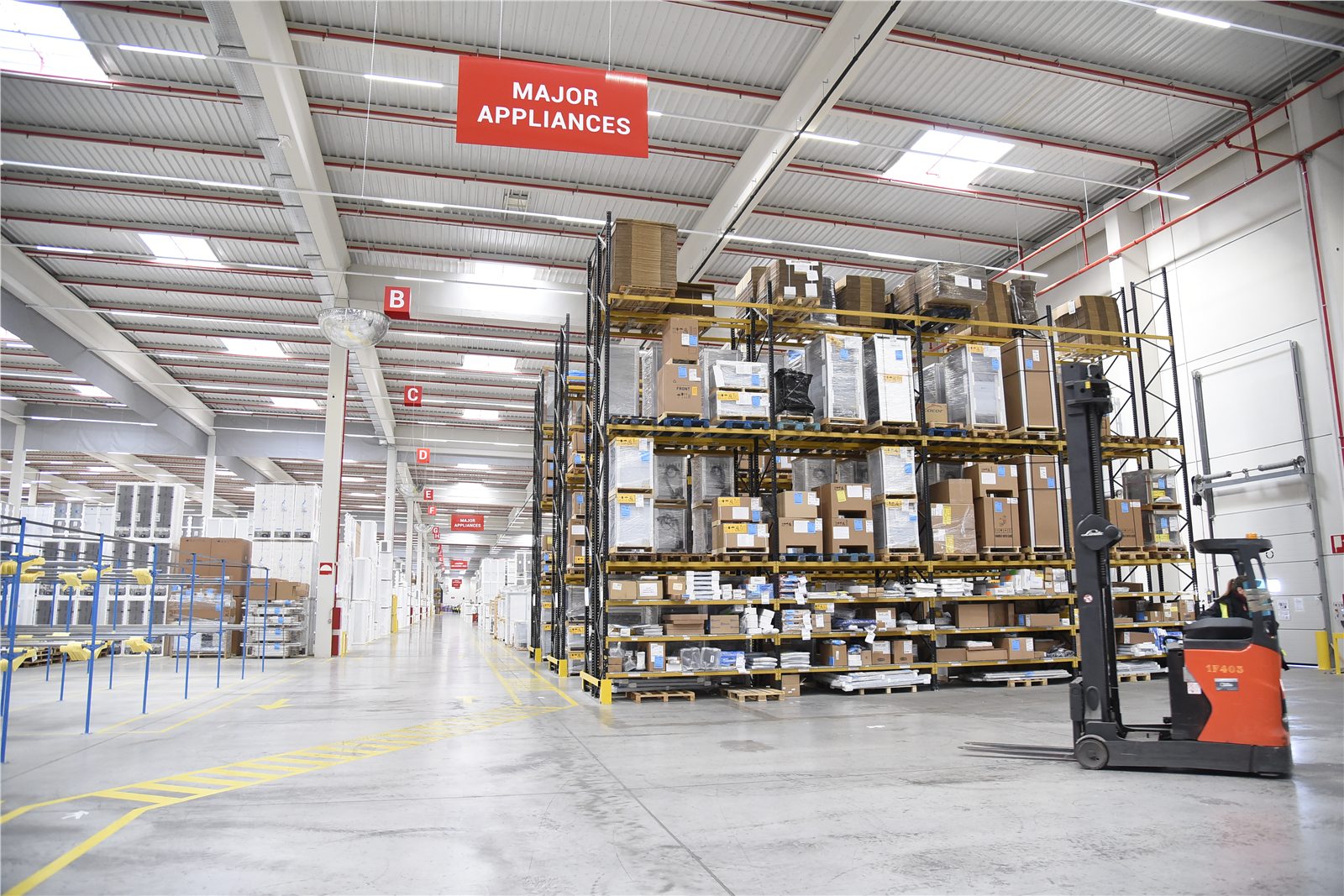
A counterbalance forklift uses a rear counterweight and front forks for lifting and handling. A reach truck is also a type of forklift, designed around warehouse storage tasks, with supporting baselegs and a mechanism that reaches the load into racking. Some designs move the mast; others extend the forks through a reach mechanism.
2. Map one real pallet journey
Write down the pickup point, travel route and final placement. Include the receiving vehicle, dock transition, door, aisle turn and storage position where relevant. A machine that fits a storage aisle may still be unsuitable for reaching that aisle from the unloading point.
For a hypothetical distributor, a short move from receiving to floor storage could suit a pallet truck. Moving the same pallet into high racking is a different task. If two machines are proposed, identify a safe transfer area and include the extra handling in the work plan. Do not assume one machine must do everything.
3. Compare the job each option is meant to do
Use this table to prepare the request. The supplier still needs the load, dimensions and route before confirming any selection.
On a small screen, scroll the table sideways. Keyboard users can focus the table area and use the arrow keys.
| Equipment | A useful starting application | Check before choosing |
|---|---|---|
| Low-lift pallet truck | Pallet transfers between floor-level points | Pallet entry, floor condition, travel distance and operator effort |
| Reach truck | Placing and retrieving pallets in compatible warehouse racking | Working aisle, baselegs, racking layout and capacity at height |
| Counterbalance forklift | General lifting, stacking and suitable vehicle-loading work | Turning space, mast clearance, rated capacity and surface suitability |
4. Measure the pallet as well as the aisle
Record pallet length, width, loaded height, gross weight and fork-entry openings. Add photos showing underside boards, skids and any load overhang. Pallet trucks are available in different fork and entry configurations precisely because not every pallet works with every truck.
For racking, provide beam heights, bay layout, load dimensions and the narrowest usable aisle. Ask for the specified working aisle for the actual truck and pallet orientation, not just the truck's body width. Reach-truck baselegs also need clearance around the pallet and racking.
If storage is double-deep, say so explicitly. The name 'reach truck' does not confirm the required reach arrangement or capacity. A truck's maximum lift height also does not prove capacity for your load at that height.
5. Surfaces and workload can reverse the shortlist
Inspect floor joints, drain covers, thresholds and changes in level. Small load wheels and low clearance make these details worth discussing, even inside a building. Do not assume a machine advertised for warehouse work can cross a rough yard or a dock transition.
Many reach trucks are intended primarily for indoor duties, although specific indoor/outdoor designs exist. Confirm the exact model's limits rather than making a blanket rule. Likewise, a counterbalance forklift needs the appropriate tyres and configuration for its route.
For repeated pallet transfers, compare manual pushing effort with a powered option. Rated pallet weight alone misses travel distance, frequency and stopping requirements. Powered equipment still requires suitable training and an assessed route; it is not automatic permission to use a slope.
6. Make the rental request specific
Ask the supplier to confirm the proposed equipment against the job, not simply replace one category name with another. Availability, operator provision and support need separate confirmation.
- Send the load and pallet dimensions, gross weight and entry-side photos.
- Provide a route sketch, narrowest aisle, doorway heights and surface photos.
- State the highest placement point and any unusual racking arrangement.
- Share travel frequency, shift hours, charging access and rental dates.
- Ask who supplies a suitably trained operator and how equipment issues will be handled.
Questions before you book
Is a reach truck always better in a narrow warehouse?
No. The truck must fit the working aisle with the actual pallet and remain compatible with the racking, entry route and floor. A narrow truck body alone does not prove it can turn and place the load.
Can a pallet truck replace a forklift?
It may cover suitable floor-level pallet transfers. A conventional low-lift pallet truck cannot replace a forklift for elevated stacking. Vehicle unloading also needs a separately confirmed access and handling arrangement.
Can one machine cover both the yard and the racks?
Possibly, if the specific configuration suits both. Check outdoor limits, aisle geometry and lifting capacity together. Two machines with a planned transfer point may be worth assessing when one cannot meet the complete route.